
Asymmetry or undesired outcome
Occasionally, filler may lead to an uneven or unintended look. If the result doesn’t align with the patient’s goals, dissolving the filler allows for a reset or refinement. This ensures a more balanced, natural appearance moving forward.
FaceMap™ Ultrasound Filler Assessment & Dissolving
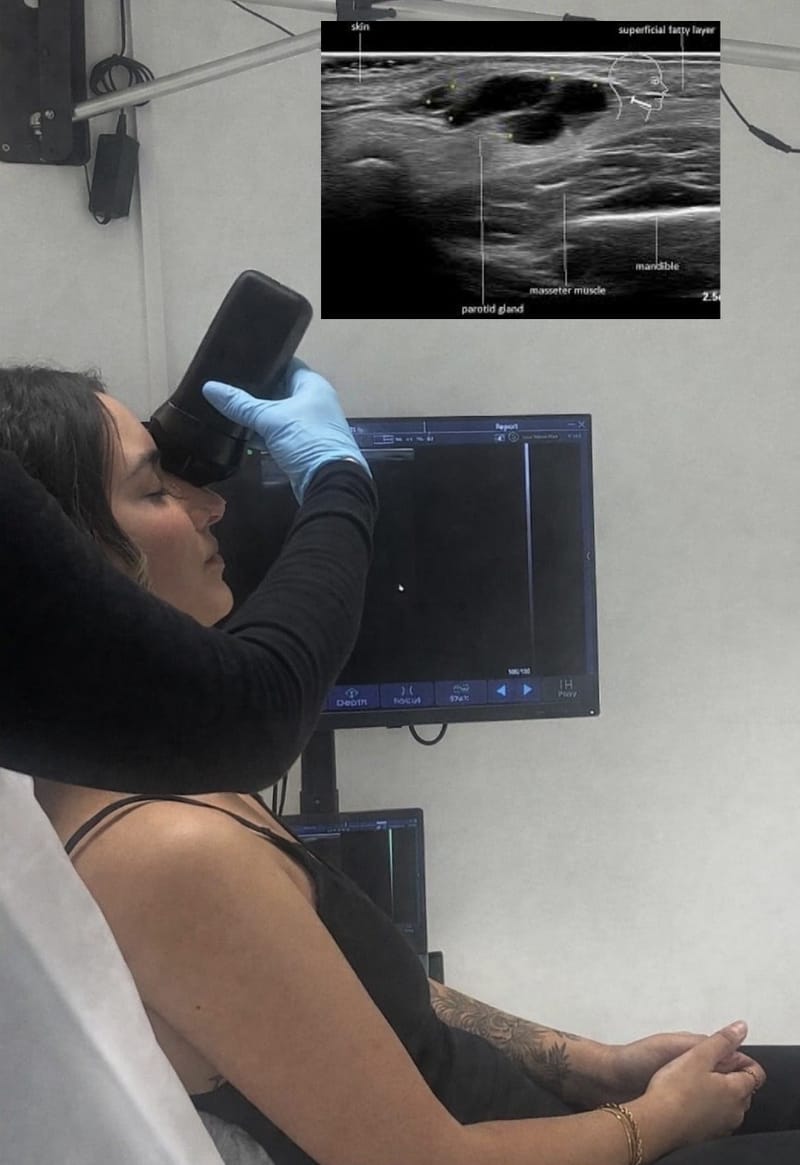
FaceMap™ Ultrasound-Guided Filler Dissolving
Advanced ultrasound assessment and precision-guided dissolving
One of the busiest uses of ultrasound in my clinic is the assessment and dissolving of long-standing dermal filler, particularly for clients preparing for facial surgery such as a facelift.
Many people attend following previous dissolving treatments elsewhere, often surprised to learn that significant amounts of filler are still present. Others attend specifically to assess whether filler remains in the face prior to surgery, or to undergo targeted dissolving to support surgical planning.
FaceMap™ ultrasound-guided filler dissolving is designed to bring clarity, precision and confidence to these situations.
Dermal filler: effective, reversible, and longer-lasting than once thought
Dermal filler is an excellent aesthetic treatment when used appropriately. It can restore structure, soften shadows and enhance facial balance beautifully.
One of the advantages of hyaluronic acid (HA) filler is that it is reversible. However, we now understand that filler often lasts far longer than originally anticipated, particularly when:
• Small amounts are added gradually over many years
• Filler is placed in certain areas of the face
• Treatments are layered rather than fully dissolved between sessions
Over time, filler may persist, spread or integrate with surrounding tissues, making it more difficult to assess and remove without imaging.
The role of ultrasound in modern aesthetic practice
Modern aesthetic practice requires not only skill, but also appropriate technology. Ultrasound provides real-time visualisation of superficial facial anatomy, allowing us to see structures that cannot be assessed by touch alone.
Ultrasound enables visualisation of:
• Skin and soft-tissue layers
• Filler deposits and distribution
• Blood vessels (with Doppler capability)
This level of detail is essential when assessing older or previously treated filler.
In my clinic, ultrasound is used frequently, particularly for complex filler assessment and dissolving. Regular clinical use allows for accurate identification of long-standing filler patterns and improves precision when planning treatment.
Why filler may need to be dissolved
There are many reasons someone may choose to dissolve filler. These reasons are common and do not mean that filler itself is unsafe or ineffective.
Changing trends and personal preference
Aesthetic preferences evolve. Treatments such as fuller lips, pronounced cheeks or a more sculpted chin may no longer reflect how someone wishes to look. Dissolving filler allows a return to a softer or more natural appearance.
Filler migration
Over time, filler can move from its original placement:
• Lip filler may migrate beyond the vermilion border or towards the wet–dry border, affecting lip shape or smile dynamics
• Cheek filler can descend with gravity and muscle movement, contributing to heaviness in the lower face
• Chin filler may migrate below the jawline, altering natural contour
Unnatural or overfilled appearance
Gradual layering of filler over many years can sometimes result in:
• Loss of natural facial contours
• Puffiness or heaviness
• Lumps or uneven texture, particularly in delicate areas such as under the eyes
Vascular occlusion and compression
In rare situations, filler can block (occlude) or press on (compress) a blood vessel, reducing blood flow to surrounding tissues. This can cause tissue damage and, in extremely rare cases, serious complications like necrosis or vision issues. In these instances, dissolving the filler promptly is essential.
Nodules or delayed reactions
In some cases, filler may contribute to delayed nodules, inflammation or recurrent localised issues. Where filler is identified as the cause, dissolving may be recommended.
Facelifts and long-standing filler
A key reason for ultrasound-guided assessment
Facelift surgery has become increasingly popular and more accessible in recent years, both in the UK and abroad. Modern facelift techniques can produce excellent, natural-looking results.
However, many individuals seeking a facelift have often had years of dermal filler treatments beforehand. This can result in:
• Multiple layers of filler at different depths
• Diffusely spread filler rather than one clear pocket
• Older filler that is difficult to identify without imaging
This type of filler is often very difficult to assess — and dissolve — without ultrasound.
Many clients attend:
• To confirm whether filler is still present following previous dissolving
• For targeted dissolving prior to facelift surgery
Ultrasound allows accurate identification of residual filler and helps guide dissolving where it is visually or structurally relevant. The aim is not always to remove every trace of filler, but to reduce filler that may interfere with natural anatomy or surgical assessment.
Why dissolving filler can be difficult without ultrasound
Filler does not always remain in one obvious location. Over time, it can:
• Disperse in very small amounts
• Sit deeper than expected
• Integrate with surrounding tissues
Without ultrasound, dissolving is often performed without visual confirmation, which can result in:
• Multiple ineffective sessions
• Excess hyaluronidase use
• Partial or inconsistent improvement
Ultrasound enables direct visualisation of filler location and depth, allowing dissolving to be targeted precisely.
How many dissolving sessions will I need?
This varies from person to person.
• Filler in a single, well-defined pocket may respond quickly
• Long-standing or diffusely distributed filler often requires multiple sessions
Dissolving is typically a gradual process, particularly where filler has been present for many years.
It is also important to understand that removing every trace of filler is not always necessary to achieve a good aesthetic or surgical outcome.
Will I see results straight away?
Hyaluronidase works quickly. However, swelling from the injection itself is common.
Typically:
• Injection-related swelling settles within 1–3 days
• Results become clearer as swelling reduces
Further sessions, if required, are planned once tissues have fully settled.
Downtime and recovery
Most people experience:
• Mild swelling
• Possible bruising
• Temporary tenderness
Downtime is usually minimal, though this varies depending on the area treated and the extent of dissolving.
Safety considerations
Hyaluronidase is widely used and generally very safe.
• Allergic reactions are rare (less than 1%) and more likely in individuals with a known bee sting allergy
• Temporary swelling or bruising may occur
Using ultrasound with Doppler capability allows identification of blood vessels, helping to minimise unnecessary trauma and bruising.
How long do I need to wait after filler dissolving?
Before having more filler
If you plan to have dermal filler placed again in the same area:
• You should wait 4–6 weeks after filler dissolving
• Waiting closer to 6 weeks is recommended
This allows the tissue space to fully heal and stabilise. Injecting filler too soon after dissolving increases the risk of:
• Filler migrating again
• Uneven results
• Poor integration of the new filler
Although older guidance suggested 2 weeks, current understanding supports a longer healing period, particularly in areas where filler migration or long-standing filler has been present.
Before facelift surgery
If filler dissolving is being performed in preparation for a facelift:
• Dissolving should be completed at least 4–6 weeks before surgery
• The exact timing should always be confirmed with your surgeon, as requirements vary
The purpose of dissolving before surgery is not always to remove all filler, but to reduce filler that may interfere with normal anatomy or surgical assessment.
Before other aesthetic treatments
For treatments such as skin boosters, energy-based treatments or further injectable procedures in the same area:
• A waiting period of 4–6 weeks is generally advised
This ensures swelling has fully resolved and tissues have returned to their normal state.
What happens next?
If you would like to discuss ultrasound-guided filler dissolving, please contact Helen to talk through your needs and options.